


Civic Math: Connecting numbers with real-life situations
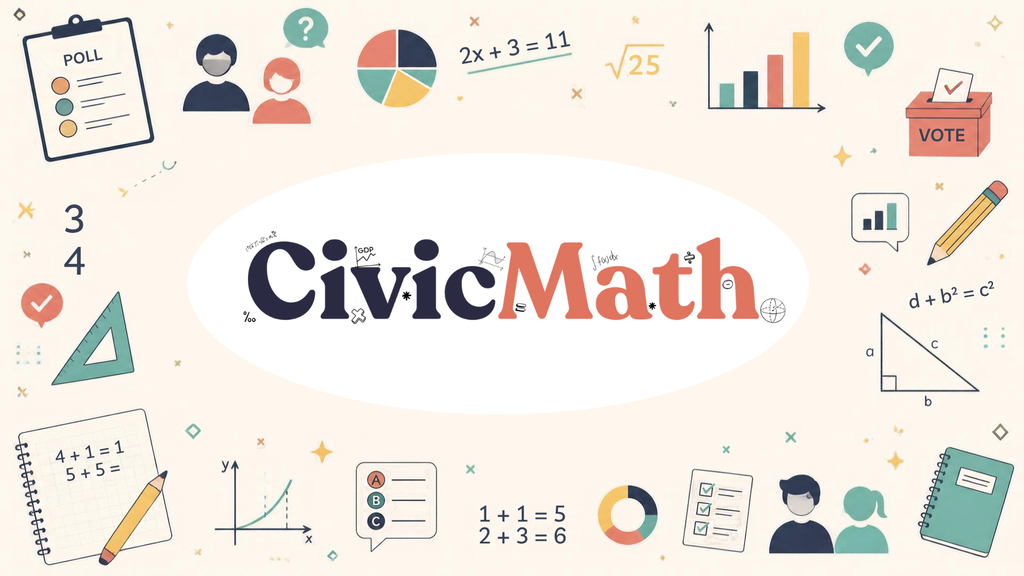
Image generated with Canva AI.
How often do you find yourself believing a headline on an Instagram post stating that “gluten is bad for your health”? Or believing a political candidate was the best choice because they were said to be the “winner” in a poll?
We all make quick judgments based on numbers, charts, or headlines. The same skills we need to question a health claim are the ones we need to read a poll, follow an election, or understand how public money is spent. In a fast-moving digital world, taking part in democracy increasingly means making sense of data.
That’s why we launched Civic Math. Our project aims to turn math from a school subject into a practical tool for active citizenship, critical thinking, and democratic engagement.
Who is it for?
Civic Math is designed for young people aged 18 to 28 in non-formal education settings such as youth clubs, community centres, and NGOs. The project offers ready-to-use resources for youth workers, trainers, and non-formal educators who lead workshops and activities for these young people. But everyone can benefit from it. 😊
What will you learn?
With Civic Math, educators and young people will learn to look at news and social media with a critical eye, spotting misleading graphics, manipulated statistics, and algorithmic bias. You will understand how democracy works, from voting systems and electoral polling to how public resources are allocated. Moreover, you will be ready to take part in community decisions with more confidence, logical rigor, and ethical awareness.
What will be available?
You will have access to a structured curriculum with practical learning plans and interactive modules covering mathematics, democracy and voting systems, media literacy, ethical decision-making, and civic responsibility. It will be supported by online training modules and e-learning videos. Everything will be gathered on a free digital platform, which will also include a collaborative space for youth workers to share best practices. NGOs and educators will also find step-by-step guidance on adapting the curriculum to their local context, along with a white paper offering evidence-based policy recommendations for math-driven civic education. All resources will be available in English, French, Romanian, Norwegian, and Polish.
Who is making it happen?
Civic Math is an Erasmus+ project, co-funded by the European Union. It brings together the expertise of a diverse consortium including Fermat Science (France), European Literacy for All Network (Belgium), YYOUTH (Norway), Fundacja Instytut Europejski (Poland), and Asociatia in Varietate Concordia (Romania).
What’s next?
Now you know why it matters and how we plan to tackle it. The first resources will be available soon on our website. Until then, save the link and stay tuned. There is much more to come!